
Blog
Nahttypen: Overview for Industry & Mechanical Engineering

In both the textile industry and mechanical engineering, Nahttypen—the various types of seams—are essential components that determine the strength, flexibility, durability, and functionality of fabricated products. While commonly associated with fashion and garment construction, Nahttypen also play a pivotal role in industrial manufacturing, automotive engineering, aerospace, and protective equipment.
This article presents an in-depth look at Nahttypen, covering their technical classifications, applications in various sectors, recent innovations, and the criteria used for selecting the appropriate seam type for a specific use case.
What Are Nahttypen?
Nahttypen is a German term meaning “types of seams.” These refer to the specific ways two or more pieces of material (typically fabric or flexible substrates) are joined together. In industrial and mechanical contexts, seams must meet stringent requirements in terms of strength, stress resistance, thermal endurance, and material compatibility.
Nahttypen aren’t limited to needle-and-thread methods. In engineering fields, they include weld seams, bonded seams, and laser-sealed seams, depending on the industry.
Importance of Nahttypen in Industrial Contexts
In industrial applications, seam failure can lead to catastrophic consequences—from machine malfunction to user injury. This makes the selection of the appropriate seam type a critical part of engineering design.
Key roles of Nahttypen in industry:
-
Ensuring structural integrity under dynamic load
-
Providing resistance to heat, pressure, and friction
-
Meeting safety standards and compliance codes
-
Contributing to the longevity of the product
For example, in automotive upholstery, seams must endure constant pressure, body heat, and movement without tearing or weakening over time.
Classification of Nahttypen
Nahttypen in industrial engineering can be broadly classified into the following categories:
-
Mechanical seams (stitched or riveted)
-
Welded seams (thermal fusion)
-
Bonded seams (adhesives or tapes)
-
Laser-sealed seams (non-contact fusing)
-
Overlocked or surged seams (often used in technical textiles)
Each category offers a specific set of benefits and limitations based on the material and use environment.
Nahttypen in Mechanical Engineering
In mechanical engineering, Nahttypen often relate to welding methods and metal joining. Seam types include:
-
Butt Weld Seams
-
Fillet Weld Seams
-
Lap Weld Seams
-
Corner and Edge Welds
Each is selected based on load direction, expected stress, and accessibility of the weld area. For example, fillet welds are widely used in steel frame construction due to their simplicity and strength.
Textile-Based Industrial Applications
In sectors like aerospace, military, and outdoor gear manufacturing, seam types must balance weight, strength, and flexibility. Seam sealing, lamination, and bonding techniques are increasingly replacing traditional stitches.
Common textile Nahttypen in industrial applications:
-
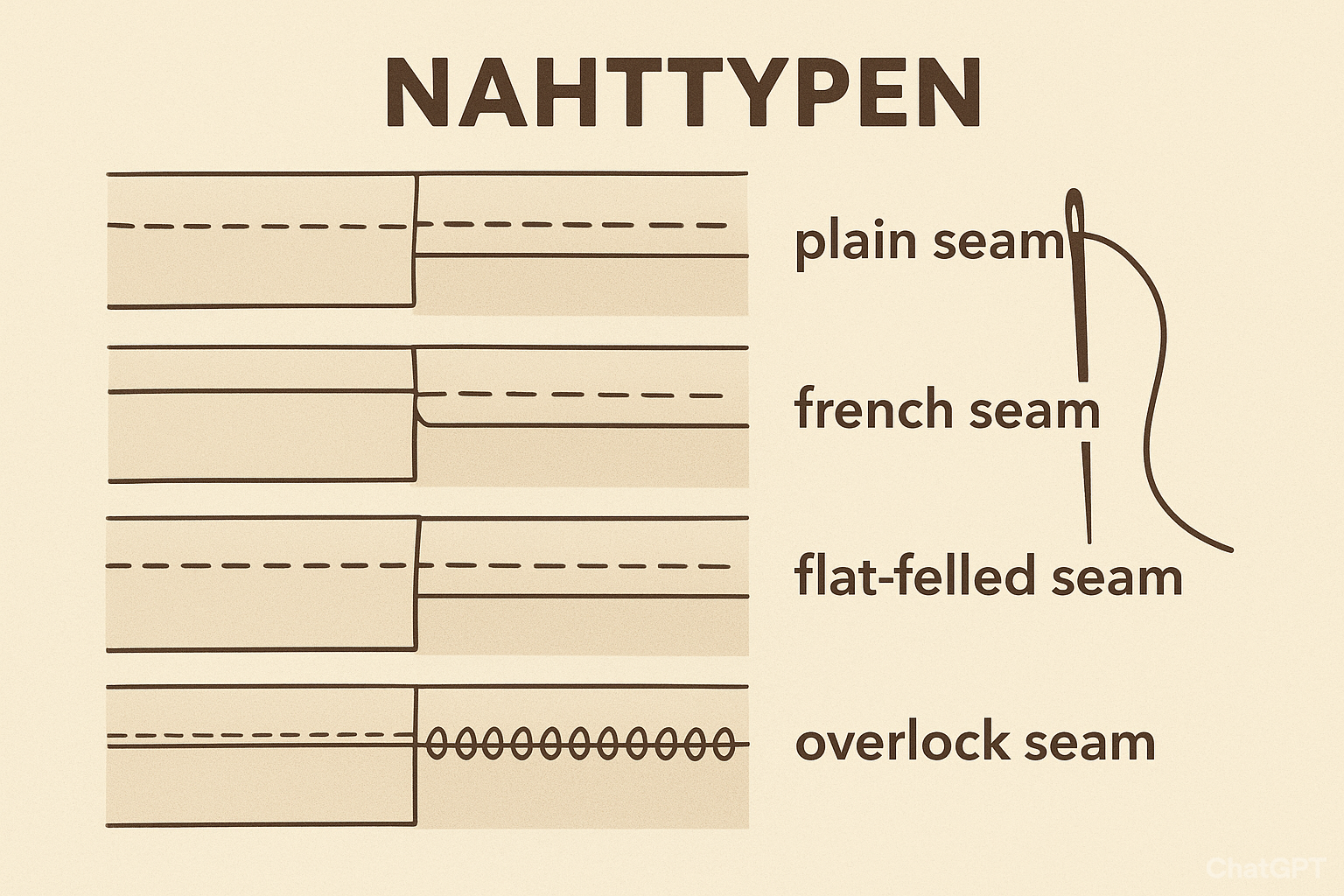
Flat-felled seams – strong and enclosed, ideal for uniforms and tents
-
Seam taping – for waterproof garments
-
Overlocked seams – fast, clean edges, commonly used in activewear and PPE
Technical Considerations for Choosing Nahttypen
When selecting a seam type for an industrial product, several technical parameters must be assessed:
| Factor | Impact on Seam Type |
|---|---|
| Material composition | Some materials melt under heat; others fray easily |
| Environmental exposure | Moisture, UV light, or chemicals may weaken certain seams |
| Load and stress | Heavy loads require reinforced or double-stitched seams |
| Flexibility requirements | Stretchable seams needed for dynamic applications |
Understanding these factors helps engineers choose Nahttypen that optimize safety, performance, and lifespan.
Seam Strength and Durability Testing
Standardized tests ensure seam integrity meets industrial requirements. These tests include:
-
Tensile strength tests (ASTM D5034)
-
Seam slippage tests
-
Abrasion resistance
-
Thermal aging simulations
For example, in parachute manufacturing, every seam undergoes load testing to guarantee user safety under high-stress scenarios.
Automation and Seam Manufacturing
Modern manufacturing relies heavily on automated seam construction. Computer-controlled sewing machines, robotic welders, and laser sealing systems have drastically improved precision and speed.
Benefits of automation in Nahttypen production:
-
Consistency in seam quality
-
Real-time quality monitoring
-
Reduced labor costs
-
Higher throughput for large-scale production
Seamless Technology and Bonded Nahttypen
A growing trend is the use of seamless technology, where seams are created without stitches. Using adhesives, heat sealing, or ultrasonic welding, bonded seams eliminate holes, reduce friction, and improve water resistance.
Applications include:
-
Sportswear and swimwear
-
Protective gear
-
Medical textiles (e.g., sterile gowns)
-
Automotive interiors
These Nahttypen offer sleek design, comfort, and high performance.
Innovations in Seam Engineering
In recent years, innovations have transformed how Nahttypen are applied:
-
Smart seams with embedded sensors (for detecting wear or temperature changes)
-
Hybrid seams that combine stitching and bonding
-
Eco-friendly adhesives for sustainable bonded seams
-
AI-driven seam optimization for predictive maintenance in machines
These technologies align with Industry 4.0 principles, making seams smarter and more integrated with overall system design.
Industry-Specific Use Cases
Let’s explore how different industries apply specific Nahttypen:
| Industry | Seam Type | Purpose |
|---|---|---|
| Automotive | Flat-felled, double-stitched | Durability and aesthetics |
| Aerospace | Bonded, laser-sealed | Lightweight, heat-resistant |
| Military | Reinforced, waterproof seams | Strength under extreme conditions |
| Sportswear | Seamless, overlocked | Comfort and stretchability |
| Medical | Ultrasonic seams | Sterility and safety |
Sustainability and Eco-Friendly Seam Solutions
With rising environmental concerns, manufacturers are now focusing on sustainable Nahttypen:
-
Water-based adhesives instead of solvents
-
Recyclable threads and tapes
-
Reduced energy welding systems
Sustainable seam technology not only reduces environmental impact but also meets growing consumer demand for eco-conscious products.
Conclusion
Understanding Nahttypen is essential in both textile and mechanical engineering. Whether it’s the intricate seams on a spacesuit or the sturdy joins in a car seat, the correct seam type determines product success or failure.
As industries continue evolving, so do the seam technologies and applications. From traditional stitch types to modern bonded and laser-sealed seams, continue to define quality, safety, and innovation.
For engineers, designers, and manufacturers, investing in seam education and research is vital. The future will not only demand stronger seams but also smarter, greener, and more integrated solutions.

Planning Coordinated Wedding Suits for the Groom and Groomsmen

How Certified Menopause Fitness Coaching Supports Midlife Fitness

How to Design a Garden That Works for Every Season

Certified CPR Training for Workplace and Safety Compliance

How To Create Tote Bags in 2026: A Step-by-Step Guide on Using Design Tools

Upgrade Your Running Performance with Watch GT Runner 2 Technology

Nervous Patients Are loving The “Calm Approach” at This Dentist Sunderland

Dentist Gateshead Explained, From Routine Checkups to Advanced Care

Assisted Living Insights: Balancing Care and Personal Freedom

The Art Deco kitchen: cooking and baking in glittering sophistication

Mary Marquardt: The Untold Story of Harrison Ford’s First Wife

How Old Is Roux Lopez? WWE Stars Becky Lynch & Seth Rollins’ Daughter

Kim Sexton Mattingly: The Woman Behind MLB Legend Don Mattingly

Ellen van Lochem: The Quiet Force Behind AC/DC Legend Angus Young

How Old Is Marina Pearl LeBlanc? All About Matt LeBlanc’s Only Child

Ringwood Church Services, Events and How to Get Involved

Raquel Pedraza: Former Tennis Player and Taylor Fritz’s Ex-Wife

Jacelyn Reeves: The Private Life of Scott Eastwood’s Mother

Who Is Norma Gibson? Ex-Wife of Tyrese Gibson Explained

Zing-Ci Leung About: Life Before and After Donnie Yen
Planning Coordinated Wedding Suits for the Groom and Groomsmen
How Certified Menopause Fitness Coaching Supports Midlife Fitness
How to Design a Garden That Works for Every Season
Certified CPR Training for Workplace and Safety Compliance
How To Create Tote Bags in 2026: A Step-by-Step Guide on Using Design Tools
Upgrade Your Running Performance with Watch GT Runner 2 Technology
Nervous Patients Are loving The “Calm Approach” at This Dentist Sunderland
Dentist Gateshead Explained, From Routine Checkups to Advanced Care
Assisted Living Insights: Balancing Care and Personal Freedom
The Art Deco kitchen: cooking and baking in glittering sophistication
-
 Celebrity1 year ago
Mary Marquardt: The Untold Story of Harrison Ford’s First Wife
-
 Celebrity1 year ago
How Old Is Roux Lopez? WWE Stars Becky Lynch & Seth Rollins’ Daughter
-
 Celebrity1 year ago
Kim Sexton Mattingly: The Woman Behind MLB Legend Don Mattingly
-
 Celebrity1 year ago
Ellen van Lochem: The Quiet Force Behind AC/DC Legend Angus Young