
Technology
How Top Ad Agencies Use Storytelling to Drive Conversions


We’ve all been there: scrolling through an endless feed, our thumbs numb from the sheer volume of content. Then, suddenly, something stops us. It’s not just an ad; it’s a tiny, compelling world that pulls us in. We feel something – a pang of empathy, a flicker of aspiration, a chuckle of recognition. That, my friends, is the magic of storytelling in advertising, and it’s how the most effective campaigns cut through the noise. Because let’s be honest, buying decisions aren’t always logical spreadsheet exercises.
More often than not, they’re deeply rooted in emotion, connection, and how a brand makes us feel.The smartest brands and the top ad agencies understand this fundamental human truth. They know that while features and benefits are important, they’re just the scaffolding. The real structure, the one that holds attention and builds loyalty, is built from stories. These aren’t just fluffy narratives; they’re meticulously crafted journeys designed to resonate, engage, and ultimately, convert.
Character + problem + solution
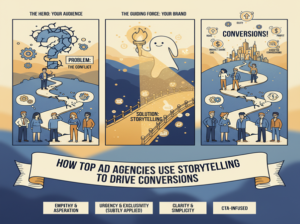
At its heart, every compelling story, whether it’s an epic novel or a 30-second commercial, follows a familiar arc: a character faces a problem, and through their journey, finds a solution. This isn’t just a literary device; it’s a powerful psychological framework that marketing video production leverages constantly to connect with audiences.
Let’s break it down:
The Character: Your Audience as the Hero
Forget the brand being the hero for a moment. In effective advertising storytelling, the audience often sees themselves, or an aspirational version of themselves, as the main character. This character isn’t perfect; they’re relatable, with desires, struggles, and everyday challenges. When you depict a character who mirrors your target demographic, you instantly forge an empathetic bond.
The audience thinks, “That’s me!” or “I know that feeling.” This immediate recognition is crucial for engagement.It’s about showing, not just telling, who your product or service is for. Is it a busy parent? A budding entrepreneur? A student juggling multiple tasks? Give them a face, a voice, a relatable context, and you give your audience permission to step into their shoes.
The Problem: The Conflict that Drives the Narrative
Every hero needs a challenge. In advertising, this “problem” is the pain point, the unmet need, the frustration your audience experiences daily. It could be anything from a clunky software interface to the struggle of finding time for self-care, or even the anxiety of making a big purchase decision. The key here is to articulate this problem clearly and authentically, without resorting to exaggeration.
When you vividly portray the problem, you validate your audience’s experiences. You show them you understand their world, their struggles. This isn’t about dwelling on negativity, but about creating tension that the audience instinctively wants to see resolved. It’s the “before” picture that makes the “after” so much more appealing.
The Solution: Your Brand as the Guiding Force
And here’s where your brand steps in – not as a cape-wearing savior, but as the wise mentor or the indispensable tool that helps the character overcome their problem. The solution isn’t just about listing product features; it’s about demonstrating how those features translate into real-world benefits that directly address the previously established problem.
Think about how a new app saves time for a busy professional, or how a sustainable product aligns with a consumer’s values. The story shows the character’s journey from struggle to success, with your brand playing a pivotal, empowering role. This narrative arc transforms your offering from a mere commodity into a valuable partner in the customer’s personal story of triumph.
CTA infused storytelling
You’ve built this beautiful narrative, connected emotionally, and shown how your brand provides the perfect solution. Now what? The call to action (CTA) isn’t an abrupt interruption; it’s the natural, satisfying conclusion to the story you’ve just told. The most effective campaigns don’t just tack on a “Buy Now” at the end; they weave the desired action seamlessly into the psychological fabric of the narrative, using triggers that feel less like a command and more like an invitation to continue the positive journey. Consider the psychological triggers at play:
Empathy and Aspiration
By showing a character’s transformation, you’ve evoked empathy. Now, your CTA can tap into that feeling of wanting a similar positive outcome. If the character achieved peace of mind, the CTA might invite the viewer to “Discover your own peace of mind.” If the character found success, it might be “Unlock your potential today.” It’s about leveraging the emotional resonance created earlier and directing it towards a tangible next step.
This approach moves beyond simple product features to connect with deeper human desires for happiness, security, success, or belonging. According to insights often shared by HubSpot, consumers are increasingly seeking authentic connections with brands, and storytelling provides the perfect vehicle for this.
Urgency and Exclusivity (Subtly Applied)
While avoiding hype, a well-placed story can create a gentle sense of urgency or exclusivity. Perhaps the character’s problem was solved just in time, or they gained access to something unique. The CTA can then mirror this, inviting the viewer to “Join the community” or “Experience the difference now” before missing out on the positive transformation.
This isn’t about manipulative tactics, but about framing the CTA as a valuable opportunity that aligns with the story’s positive resolution. The best top ad agencies understand that the CTA should feel like the natural next chapter for the viewer, not a forced sales pitch.
Clarity and Simplicity
Even with all this psychological finesse, the CTA itself must be crystal clear. After the emotional journey, don’t leave your audience guessing. “Learn More,” “Sign Up,” “Get Started,” “Watch the Full Series” – whatever the action, it should be unambiguous and easy to execute. The story creates the desire; the CTA provides the clear path.
Think with Google often highlights the importance of frictionless user journeys. If your story builds desire but your CTA is confusing or hard to find, you’ve lost the plot. A compelling narrative deserves a clear, satisfying conclusion that guides the audience to their own “happily ever after” with your brand.
Key Takeaways
- Emotion, not just logic, is the primary driver behind most purchasing decisions.
- Effective advertising uses a clear narrative arc: a relatable character faces a problem, which your brand then helps them solve.
- The audience should see themselves as the “hero” in the story, fostering empathy and aspiration.
- Your brand serves as the guide or tool that empowers the character to overcome their challenges.
- Calls to action (CTAs) should be seamlessly integrated into the story’s resolution, acting as a natural next step for the viewer.
- Psychological triggers like empathy, aspiration, and a subtle sense of opportunity make CTAs more compelling and less like a direct sales pitch.
Conclusion
In a world saturated with information, the brands that truly stand out are those that master the art of storytelling. It’s not about shouting louder; it’s about speaking to the heart. By crafting narratives that resonate on a human level, that acknowledge struggles and offer genuine solutions, businesses can build far more than just sales figures – they can build lasting connections and brand loyalty. So, next time you’re thinking about your marketing strategy, remember the power of a good story. It might just be the most potent tool in your arsenal.

Planning Coordinated Wedding Suits for the Groom and Groomsmen

How Certified Menopause Fitness Coaching Supports Midlife Fitness

How to Design a Garden That Works for Every Season

Certified CPR Training for Workplace and Safety Compliance

How To Create Tote Bags in 2026: A Step-by-Step Guide on Using Design Tools

Upgrade Your Running Performance with Watch GT Runner 2 Technology

Nervous Patients Are loving The “Calm Approach” at This Dentist Sunderland

Dentist Gateshead Explained, From Routine Checkups to Advanced Care

Assisted Living Insights: Balancing Care and Personal Freedom

The Art Deco kitchen: cooking and baking in glittering sophistication

Mary Marquardt: The Untold Story of Harrison Ford’s First Wife

How Old Is Roux Lopez? WWE Stars Becky Lynch & Seth Rollins’ Daughter

Kim Sexton Mattingly: The Woman Behind MLB Legend Don Mattingly

Ellen van Lochem: The Quiet Force Behind AC/DC Legend Angus Young

How Old Is Marina Pearl LeBlanc? All About Matt LeBlanc’s Only Child

Ringwood Church Services, Events and How to Get Involved

Raquel Pedraza: Former Tennis Player and Taylor Fritz’s Ex-Wife

Jacelyn Reeves: The Private Life of Scott Eastwood’s Mother

Who Is Norma Gibson? Ex-Wife of Tyrese Gibson Explained

Zing-Ci Leung About: Life Before and After Donnie Yen
Planning Coordinated Wedding Suits for the Groom and Groomsmen
How Certified Menopause Fitness Coaching Supports Midlife Fitness
How to Design a Garden That Works for Every Season
Certified CPR Training for Workplace and Safety Compliance
How To Create Tote Bags in 2026: A Step-by-Step Guide on Using Design Tools
Upgrade Your Running Performance with Watch GT Runner 2 Technology
Nervous Patients Are loving The “Calm Approach” at This Dentist Sunderland
Dentist Gateshead Explained, From Routine Checkups to Advanced Care
Assisted Living Insights: Balancing Care and Personal Freedom
The Art Deco kitchen: cooking and baking in glittering sophistication
-
 Celebrity1 year ago
Mary Marquardt: The Untold Story of Harrison Ford’s First Wife
-
 Celebrity1 year ago
How Old Is Roux Lopez? WWE Stars Becky Lynch & Seth Rollins’ Daughter
-
 Celebrity1 year ago
Kim Sexton Mattingly: The Woman Behind MLB Legend Don Mattingly
-
 Celebrity1 year ago
Ellen van Lochem: The Quiet Force Behind AC/DC Legend Angus Young